ADVERTISEMENT
My daughter lost her father when she was six years old.
Not gradually.
Not gently.
The officers came to our home in uniform.
Their faces were careful.
The kind of careful that adults use when they know they are about to break a child’s life.
“Ma’am… we regret to inform you…”
But I do remember my daughter.
Alice.
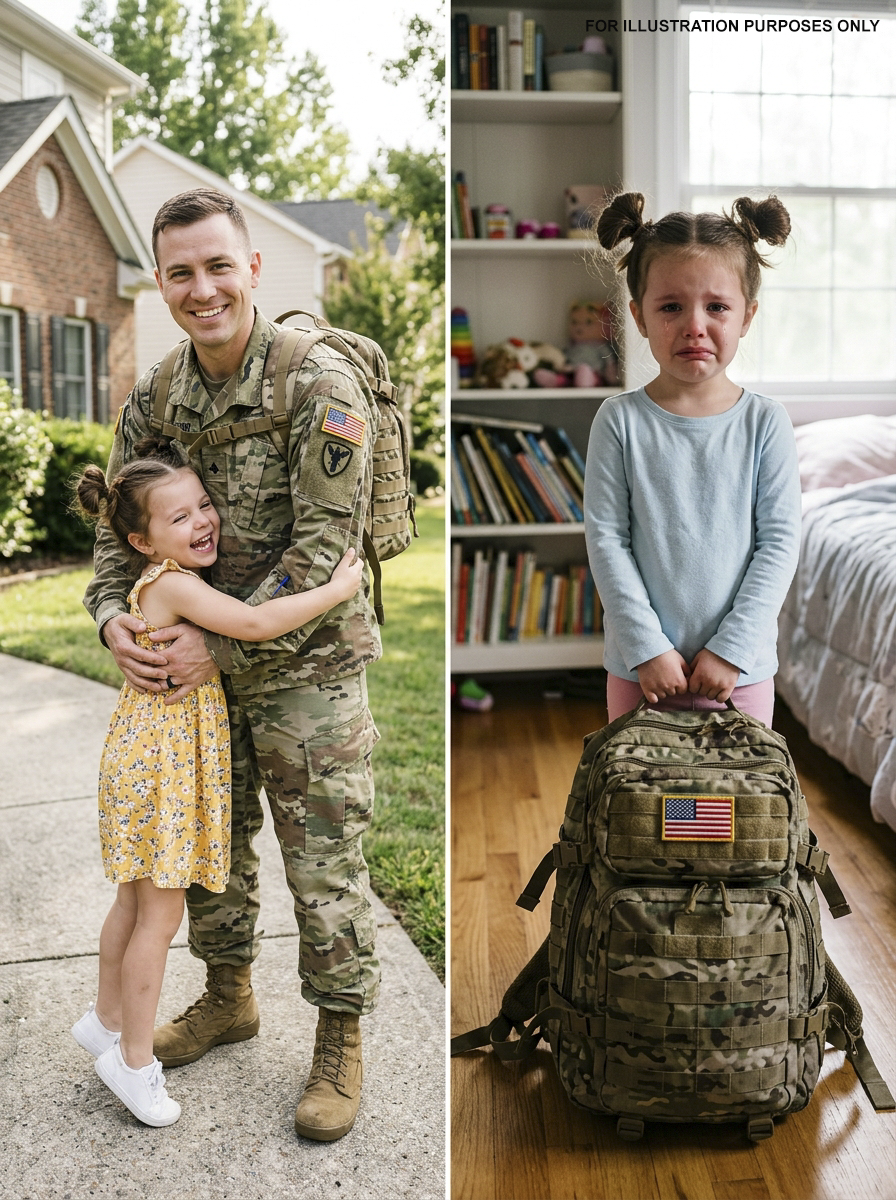
Holding his military backpack.
Like it was the only thing keeping her anchored to reality.
Not at first.
And whispered something I will never forget.
“Daddy carried this.”

Her fingers traced the worn fabric slowly.
Like she was memorizing him through cloth and stitching.
The backpack was old.
Frayed straps.
Faded color.
Dirt still embedded in places no one had bothered to clean.
It had come back with him.
And it had stayed when he didn’t.
From that day on, she refused to let it go.
Not for school.
Not for outings.
Not for anything.
At first, I thought it was just grief.
A phase.
A child holding onto the last physical piece of her father.
So I didn’t stop her.
I even helped adjust the straps when it was too big for her small shoulders.
It always looked oversized on her.
Dragging slightly against her back.
But she didn’t care.
Because it wasn’t a backpack to her.
It was him.
We went to a store once.
Bright lights.
Colorful shelves.
Rows of shiny new backpacks covered in glitter, cartoons, and patterns meant to appeal to children.
I tried gently.
“What about a new one? Something lighter?”
She looked at them.
Then at me.
And shook her head.
“I want this one,” she said softly.
“This was Daddy’s.”
Her hand tightened on the strap.
“It still smells like him.”
My throat tightened instantly.
I had no response that wouldn’t break me.
So I just nodded.
And that was the end of that conversation.

I knew school would notice.
I just didn’t expect how quickly cruelty would follow.
At first, it was small things.
Stares.
Whispers.
Children pointing when she got out of the car.
Then came the laughter.
The questions.
The confusion from other kids who didn’t understand why she carried something so old.
I would ask her every afternoon,
“How was school?”
And she would always answer the same way.
“Fine.”
Too quickly.
Too controlled.
Like she was trying to protect me from something.
Or herself.
The breaking point came in second grade.
She came home slowly that day.
Not her usual energy.
Not her usual chatter.
She stood in the doorway of the kitchen for a long time before speaking.
“Mom?”
“Yes, sweetheart?”
She hesitated.
Then said quietly,
“A girl asked me why I carry a trash bag.”
I froze.
“What did she say exactly?”
“She said my parents must be poor.”
My chest tightened immediately.
“And what did you say?”
“…nothing.”
That word hurt more than anything else.
Because I knew my daughter.
She had something to say.
She just wasn’t saying it anymore.
The next morning, I went to the school.
I spoke to her teacher first.
Then the counselor.
I explained everything.
About her father.
About the backpack.
About what it meant.
The counselor nodded sympathetically.
But her words made my stomach drop.
“Children notice differences,” she said calmly. “Sometimes the easiest solution is to reduce what makes them stand out.”
I blinked.
“You mean take away the backpack.”
The teacher nodded.
“It might help her fit in better.”
“And if she is attached to it,” the counselor added, “that could be addressed in therapy.”
I stared at them.
And something inside me went cold.
Because I realized they weren’t hearing me.
They weren’t protecting her.
They were trying to erase what made her different so others wouldn’t have to adjust.
I left that office with a sinking feeling I couldn’t explain.

After that, things got worse.
Not better.
Worse.
One afternoon, she came home without saying hello.
She walked straight to her room.
I followed her.
“Sweetheart?”
She stopped in the hallway but didn’t turn.
“A girl asked if I use a trash bag for school because I live in a dumpster.”
Silence.
Then she added quietly,
“She said my dad’s things belong there.”
Then she closed the door.
And I heard her crying.
I stood outside for a long time.
Unable to move.
Unable to fix it.
But she still wore the backpack the next day.
Red eyes.
Swollen face.
But still carrying it.
“I’m not leaving him at home,” she said.
And I nodded.
Because I understood.
Even if the world didn’t.
Then came the phone call.
11:12 a.m.
The school.
My hands were shaking before I even answered.
“Ma’am, you need to come immediately,” her teacher said.
“What happened to my daughter?”
A pause.
Then,
“You won’t believe what they did.”
I grabbed my keys.
And left.
On the way, I made one call.
Because I knew this time I wasn’t going alone.
When I arrived, he was already there.
My husband’s closest friend.
And behind him were others.
Three men.
One woman.
All in military dress uniforms.
People noticed immediately.
Hallways changed as we walked through.
Conversations stopped.
Eyes followed us.
Something serious was coming.
And everyone felt it.
When we reached the office, I saw her.
My daughter.
Alice.
Sitting in a chair.
Small.
Shaking.
Her face red and tear-stained.
And on the table in front of her the backpack.
But not as it should have been.
It was dirty.
Ruined.
Covered in dark stains.
Banana mush smeared across the zipper.
Something foul and sticky dripping down the side.
My stomach turned instantly.
“What happened?” I asked.
Her teacher looked shaken.
“During lunch… students took her backpack.”
One of the children spoke up quietly.
“They threw it into the trash.”
Another added,
“She tried to get it back… but they wouldn’t let her.”
My hands clenched.
Something inside me went very still.
Too still.
Behind me, Ryan stepped forward.
“May I say something?”
I nodded.
Because I couldn’t trust my voice.
He looked at the children.
Then at the parents.
Then at the room.
“That backpack belonged to a man I served with,” he said.
“He carried it through combat.”
His voice hardened.
“It came home because he didn’t.”
Silence filled the room instantly.
“You didn’t just mock a backpack,” he continued.
“You mocked a man who died serving this country.”
No one spoke.
No one moved.
I turned to the adults.
“You were told,” I said.
“I came here weeks ago.”
“I explained everything.”
“And I was told to remove the backpack instead of addressing the bullying.”
The counselor tried to respond.
“We thought—”
“You thought it was easier to change her than stop them.”
Silence again.
My daughter began crying harder.
I pulled her into my arms immediately.
And for a moment, everything else disappeared.
Then something unexpected happened.
One of the girls started crying too.
Then the boy.
Then another girl.
Apologies came out in broken voices.
“We didn’t know…”
“I’m sorry…”
“We thought it was just old…”
But I interrupted.
“Do you understand now?”
They nodded.
But understanding came too late.
Ryan stepped forward again.
“This isn’t just about punishment,” he said.
“It’s about respect.”
And for the first time, the room didn’t argue.
The backpack was cleaned days later.
Carefully.
Respectfully.
Not thrown away.
Not replaced.
Restored.
Just like her memory of it deserved.
At school assembly later, something changed.
The same children stood up and apologized publicly.
Staff admitted failure.
And my daughter stood in front of her class holding the backpack.
Her voice shaking at first.
Then steady.
“This was my dad’s,” she said.
“He died overseas.”
“I bring it because it makes me feel close to him.”
“It’s old… but that doesn’t mean it’s trash.”
She paused.
Then added,
“Some things matter even if people don’t understand them yet.”
Silence followed.
Then something else.
Respect.
That night, I sat in the car and cried.
Not because of what was lost.
But because of what had finally been seen.
Grief doesn’t disappear.
It transforms.
And love doesn’t leave things behind.
It holds on.
In fabric.
In memory.
In a worn-out backpack carried by a child who just wanted to feel close to her father.
And for the first time in a long time she wasn’t alone in that anymore.
ADVERTISEMENT
