ADVERTISEMENT
My father abandoned my mother after the worst night of her life, and he has not returned for 30 years. Then he showed up at our door on my birthday, asking for assistance, and I told him I would give it to him on one condition.
The Night That Changed Everything
I’m thirty-two years old today, but I only exist because my mother ran through a burning house carrying me in her arms when I was two years old.
A gas leak caused an explosion in the middle of the night. My father was away on a business trip, leaving only my mother and me at home. She woke up to smoke and flames, rushed into my room, pulled me from my crib, and somehow made it outside alive.
She saved my life.
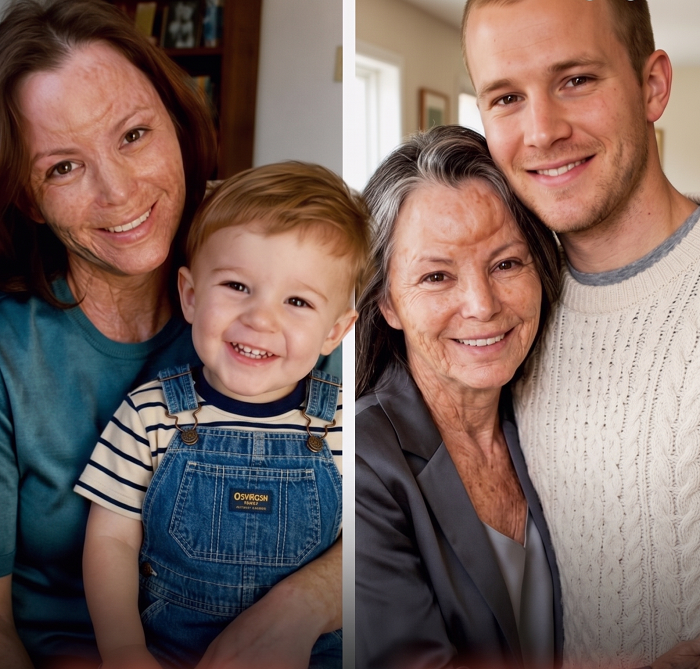
But the fire left permanent scars on her face, neck, and shoulder.
As a child, I asked her what had happened. She never made herself a victim.
“The house caught fire,” she’d say calmly. “I got you out. That’s all.”
But it wasn’t all.
The Man Who Walked Away
When my father returned from his trip and saw her after the hospital, he didn’t thank her for saving our family.
Instead, he looked at her scars.
Years later, my mother admitted what he had said.
He told her he couldn’t live with the constant reminder of the accident. He said he still had time to build a different life with someone he could admire.
Then he left.
No custody battle.
No birthday cards.
No phone calls.
No visits.
Nothing.
Just like that, he disappeared from our lives.
My mother never spoke about him with bitterness. She simply worked.
While enduring painful skin treatments she could barely afford, she also worked double shifts at a diner to keep a roof over our heads.
She never complained.
She never asked for sympathy.
And she never made me feel like I was a burden.

My Mother’s Greatest Lesson
When I turned sixteen, I got a part-time job stocking shelves in a department store.
When my mother found out, she was furious.
“You should be studying,” she said.
“I am studying.”
“You are not taking a job because of me.”
I smiled.
“I’m taking a job because groceries cost money.”
That finally made her laugh.
After that, she stopped arguing.
I stayed in retail for years, learning everything I could. I saved every extra dollar, worked every opportunity I was given, and eventually opened my own clothing store.
By twenty-nine, I owned my own business.
For the first time in her life, my mother could finally slow down.
She had earned that peace.
The Knock at the Door
Last week was my birthday.
We were celebrating quietly in her backyard with burgers, grilled corn, and lemonade when someone knocked on the front door.
Neither of us was expecting visitors.
I went inside and opened the door.
A thin, tired-looking man stood on the porch wearing worn-out clothes and nearly broken shoes.
I recognized him immediately.
I had his eyes.
My father.
Behind me, I felt my mother freeze.
He cleared his throat.
“Hey, son.”
The word sounded strange coming from him.
“What do you want?” I asked.
Why He Came Back
He looked older than I remembered.
Smaller, somehow.
Then he told us his story.
His second marriage had failed.
He had gone bankrupt.
He had lost his savings, his home, and nearly everyone willing to help him.
Finally, he said the sentence that almost made me laugh.
“I didn’t know where else to go.”
Of course he didn’t.
He hadn’t searched for us when life was good.
He had searched for us because he needed something.
My mother turned away before he finished speaking.
“I’m not doing this.”
But I kept looking at him.
And suddenly I knew exactly what I was going to do.

One Condition
“I’ll help you,” I said.
My mother whipped around in shock.
He stared at me.
“You will?”
“Yes.”
Relief flooded his face instantly.
Then I added:
“But only if you agree to one condition.”
“Anything.”
“Tomorrow morning, you’re getting in the car with us.”
“Where are we going?”
I looked him straight in the eye.
“Back to the place where you left us.”
The next morning, we drove to the property where our old house had once stood.
The house was gone.
In its place sat a small rental home with an aging porch and a leaning fence.
The owner, an elderly man named Walt, happened to be outside.
After hearing who we were, Walt told us something surprising.
Years earlier, during renovations, workers had discovered a metal recipe box wrapped in oilcloth and buried near the foundation.
He had kept it all these years because it seemed important.
My mother’s eyes immediately filled with tears.
“Was it blue?” she asked.
Walt nodded.
She covered her mouth.
“I buried that.”
The Letter
Inside the box were family photos, old recipe cards, and an envelope addressed to my father.
My mother explained what happened.
After my father abandoned us, she had returned to the property one final time before demolition. She placed precious memories inside the box, including a letter she had written but never mailed.
I handed the envelope to him.
“Open it.”
He hesitated.
Then he read.
The letter wasn’t angry.
It wasn’t desperate.
She simply wrote that her son was alive because she had carried him through fire.
She wrote that even if he could no longer love her, he still had a responsibility to love the child she had saved.
And she wrote one final truth:
She would not spend her life begging a coward to become decent.
When he finished reading, he sat on the porch steps and buried his face in his hands.
For the first time, I saw genuine shame.
“I’m sorry,” he whispered.
I believed he meant it.
But that wasn’t enough.
I looked at Walt.
“You still need work done around here?”
Walt glanced at the sagging porch and crooked fence.
“Sure do.”
Then I turned back to my father.
“Good.”
He frowned.
“What does that mean?”
“It means before I help you, you’re going to repair this place.”
“I came here for help.”
“Exactly.”

Earning a Second Chance
For the next week, he worked.
Not symbolically.
Actually worked.
He replaced rotten boards.
Straightened fence posts.
Carried lumber.
Sweated.
Struggled.
Got blisters.
Got sunburned.
And stayed quiet.
My mother refused to visit at first.
But on the third day, she arrived carrying iced tea.
She placed a cup near him and said:
“Check the support beam before covering it. Rotten wood doesn’t get stronger because you hide it.”
Then she walked away.
The message wasn’t about the porch.
Later that week, while digging near the property, they discovered a carved wooden piece from my old crib.
My grandfather had built that crib by hand.
Everyone thought it had been destroyed in the fire.
My mother held the small piece of wood carefully and traced the carved star with her finger.
“I thought all of it was gone,” she whispered.
For a moment, it felt as though the past had returned something valuable to us.
The Final Decision
By the end of the week, the porch stood solid and the fence stood straight.
My father looked exhausted.
Older.
Humbled.
“I did what you asked,” he said.
“You did.”
“So what happens now?”
I gave him one month.
A room above my store.
Food.
Time to find work.
Nothing more.
When he reminded me that he was my father, I answered honestly.
“Biologically, yes.”
He nodded because he knew I was right.
Then he turned to my mother.
“I know I don’t deserve another chance.”
She looked at him calmly.
“No. You don’t.”
What I Learned
A few days later, I had the recovered piece of crib wood mounted on a plaque.
Beneath the carved star, I added a single sentence:
Made worthy before the world said otherwise.
Today it hangs in my clothing store.
My mother stood beside me when I installed it.
My father happened to be there too.
And in that moment, I realized something important.
I hadn’t taken him back to that property to humiliate him.
I did it because too many people mistake regret for repair.
They’re not the same thing.
Feeling sorry is easy.
Doing the work to make things right is what matters.
And sometimes, the lesson someone needs most is learning the difference.
Note: This story is a work of fiction inspired by real events. Names, characters, and details have been altered. Any resemblance is coincidental. The author and publisher disclaim accuracy, liability, and responsibility for interpretations or reliance. All images are for illustration purposes only.
ADVERTISEMENT
